You don’t need toothpaste.
No matter how advertisements tell you toothpaste is a necessary step in your nighttime (or morning, or daytime) routine, it hasn’t been this way forever. It’s obvious once you think about it—of course we don’t need toothpaste. We went years, decades, centuries, millenia without toothpaste.
Not to say that we don’t need toothpaste at all in the modern day—after all, we consume much more sugary foods now than we did in the past, which does cause damage to us. But even as this was happening, people didn’t use toothpaste every day, with only about 10% of American households even owning toothpaste in their medicine cabinets.
So why do millions of people around the world use it so often?
The answer is an easy key to building new habits and keeping them consistent.
Cue & response
Claude Hopkins knew how to sell. He sold Quaker Oats into fame and bottles upon bottles of tonics that were said to cure just about anything to people all across America. When he was asked to sell Pepsodent, he followed the same formula he had been using for the previous products: find a cue, then advertise Pepsodent as the solution.
He found a cue eventually—mucin plaques on teeth that he dubbed “the film.” Removal of this “cloudy film” by way of brushing teeth with Pepsodent was supposed to give people beauty and health all at once.
This cue was easy enough to be triggered instantly whenever the customer remembered it. They would remember the “film,” feel their teeth, and remember to brush for that “Pepsodent smile.” This happened all across the world, and eventually, people were brushing their teeth every day.
And so, Pepsodent rose to popularity.
The mechanics behind habit-building are the same. Find a cue and reward, and the habit is yours. For example, continuing the theme of dental care: every time you finish brushing your teeth and put away your toothbrush (cue), remember to floss for better teeth in old age (reward). Or, you know, so you can truthfully tell your dentist that you actually floss regularly.
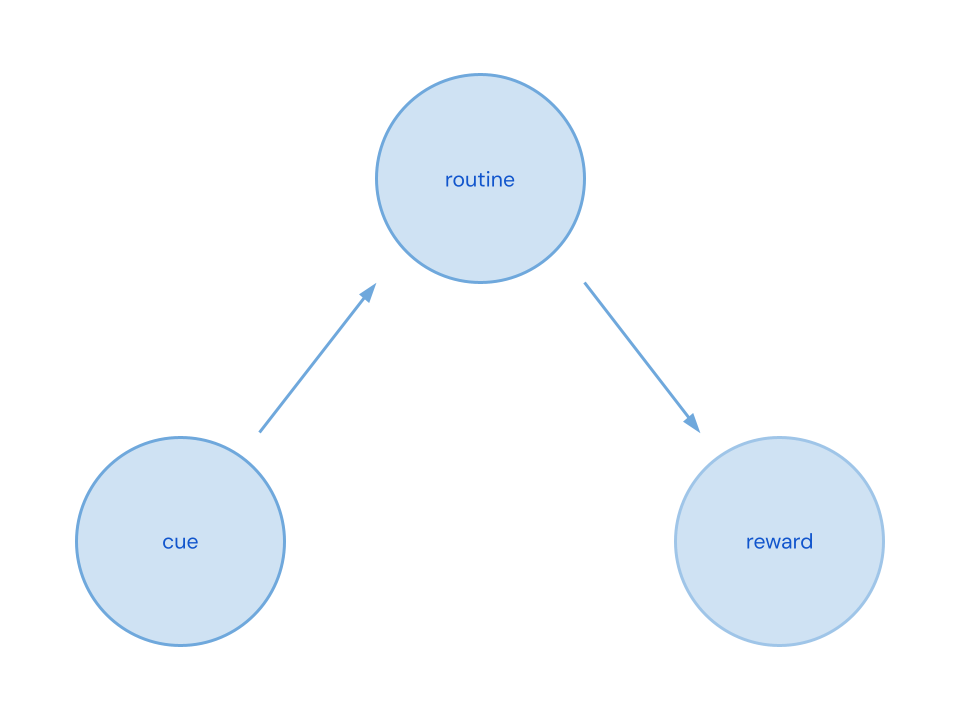
A simple graphic model of the cue-routine-reward loop (image source: Hanbi Gim)
(And another tip: doing something every day is often easier than doing just every once in a while. Just look at Quaker Oats—it grew and grew once the advertisements were telling people they needed to eat it every day for it to give them 24-hour energy. Thanks, Claude Hopkins!)
Brain structures
The part of the brain that controls automatic routines (habits) is the basal ganglia—a structure very close to the center of the skull and about as large as a golf ball. When it is activated in recognizing the cue and running the response, the gray matter of the brain is free to focus on other thoughts.
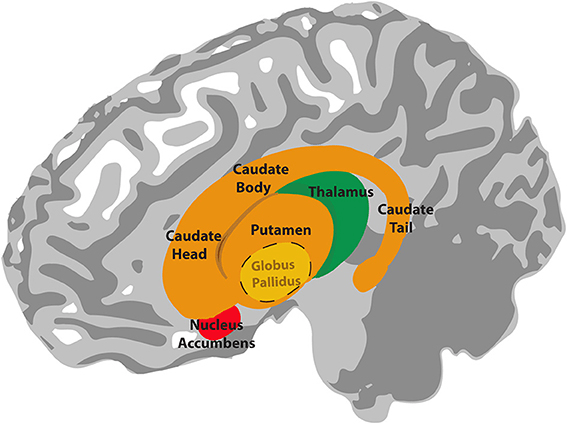
Anatomy of the basal ganglia (image source: Wikimedia Commons)
The basal ganglia is in control of much more than brushing teeth or entering passwords, though—basal ganglia damage can affect people’s ability to do basic activities such as make decisions or even open doors. This is because the brain loses the ability to ignore smaller details and instead wants to focus on everything all at the same time. For example, people with basal ganglia damage will have trouble reading emotions from faces, as the person is perpetually uncertain about which part of the face to focus on.
Something fascinating that occurs was found in a study of a patient with a weakened memory—referred to in this book as Eugene, or E.P.—and the way his habits remembered more than his active brain did.
Eugene’s memory was greatly damaged—he couldn’t remember whether he had breakfast or not that day, so often he would have multiple breakfasts; whether a show had a new episode or was airing old ones, it would be a new experience to him every time; and he couldn’t even remember his own house address. Here was a subject that could be tested entirely on the power of his basal ganglia’s retention over active memory.
His habits and memory were tested in a lab experiment in which he turned over objects that were “incorrect” or “correct” in a random pattern. The objects would be placed in front of him two at a time, with the word “correct” printed on the bottom of a random choice out of the two. Repeated tests would essentially test the memorization the person had of the objects in order.
At the beginning, Eugene didn’t remember anything—not even what the activity was or what his goal was (to overturn the “correct” item). After repeating the test many times, though, his habits allowed him to remember what the activity was and which objects were marked correct even without knowing why.
When presented with the blocks out of the typical order they were presented in—instead all together in one big pile—Eugene didn’t know where to start. He even began to try to turn over the objects without being told to, and when asked why, he just responded with “That’s just a habit, I think.”
This explained why how he couldn’t remember his own house address or location but could go on a walk every day—the cues were there (a particular mailbox, or an extra-tall tree, or a bench on the sidewalk), so the basal ganglia remembered.
Habits are like compulsions, weaponized—and this is one of the keys to changing your life, step by automatic step.
Resources:
The book used for information in this post was The Power of Habit by Charles Duhigg.
Any other resources cited in text.
 tabamilk - hanbi's musings
Leave a comment