(Disclaimer: a less common post type. More of a bullet point summary than a written article)
Synesthesia: a neurological condition in which stimulation of one sensory or cognitive pathway leads to automatic, involuntary experiences in a second sensory or cognitive pathway
Synesthete: a person with synesthesia
Some basic information from the book:
- Some of the most common types of synesthesia include grapheme-color (for example, A → red) and day-color (for example, Tuesday → orange), though there are many more—there are thought to be 60–80 total subgroups of synesthesia.
- There are signs of a genetic component
- Something fascinating here is that once, a synesthetic child complained that their letter blocks were “the wrong colors.” The mother agreed, as she also had synesthesia and saw the letter blocks as “incorrectly” colored as well.
- Even for the same subgroup of synesthesia (for example, grapheme-color in which A is red), there can be stronger and weaker associations—for example, while D is very strongly brown, O may have little to no color at all.
- Synesthetic associations are always consistent over weeks, months, and even years, though they can temporarily change if the association is weak or gradually shift over time.
- Synesthesia can be shown through MRI scans, meaning it is not an entirely imagined experience. Synesthetically perceiving blue shows different brain activity than if the same person were to simply imagine the color blue.
- There is a synesthetic Stroop effect—when a grapheme-color synesthete was memorizing completely black-and-white matrices of numbers or congruently-colored (numbers colored in the same colors as synesthetic associations) matrices, the synesthete outperformed average non-synesthetes. However, when memorizing an incongruent matrix, the synesthete’s performance dropped drastically.
- Note: an example of a non-synesthetic Stroop effect is when one attempts to read, for example, a red-colored word that spells out “brown” visually and say “red” out loud. Doing this continuously will often slow readers down, as they attempt to read the word rather than the color.
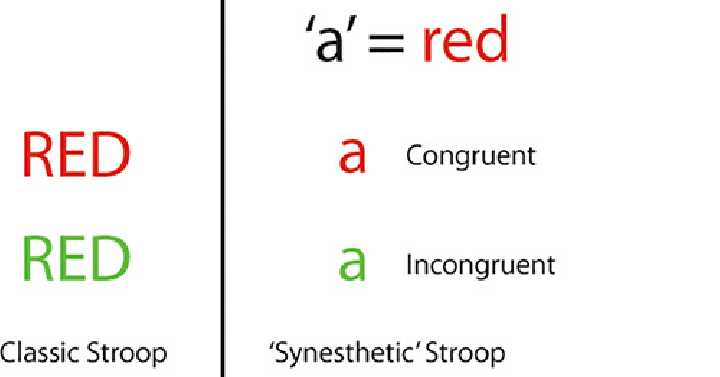
An example of a classic vs. synesthetic Stroop effect (image source: ResearchGate)
Extra information/facts:
- About 3–5% of people are thought to have synesthesia
- Note from book: however, there is the theory that everyone has mild synesthetic associations
- Associations often emerge in childhood but there are some ways they can form in adulthood:
- Temporarily: from drugs, sensory deprivation, or even meditation
- Permanently: from head trauma, stroke, or brain tumors
- Synesthetes and non-synesthetes show differences in white and gray matter (brain structure)
- There are signs of greater creative imagery skills in synesthetes, shown by greater ease in coming up with metaphors
- The superior posterior parietal cortex is significant in synesthesia
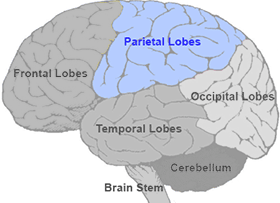
Image of the parietal lobe’s location in your brain (image source: Brain Map: Parietal Lobes – Queensland Health)
Resources:
The book used for information in this post was Wednesday is Indigo Blue by Richard E. Cytowic M.D. and David M. Eagleman Ph.D.
Any other resources cited in text.
 tabamilk - hanbi's musings
Leave a comment